
The necessary ingredients of a good MVP story
In building stellar digital products and their experiences in the early stage, the story that you tell helps articulate the purpose, value, and capabilities of the product. In the early stages, it is critical to be able to move fast and be agile.
The key to successful innovation is to be able to bring about a balance between three critical responsibilities within the product team (and their teams); viability(business), desirability(design), and feasibility(technology). When you are just starting up with your idea, especially if you are going to be bootstrapping it, it is critical that you set up the right mechanisms to enable collaboration between these functions.
“The key to successful innovation is to be able to bring about a balance between teams that represent three critical objectives within the product team; viability, desirability, and feasibility.”
For any typical software development project the process from a team perspective looks somewhat like this:
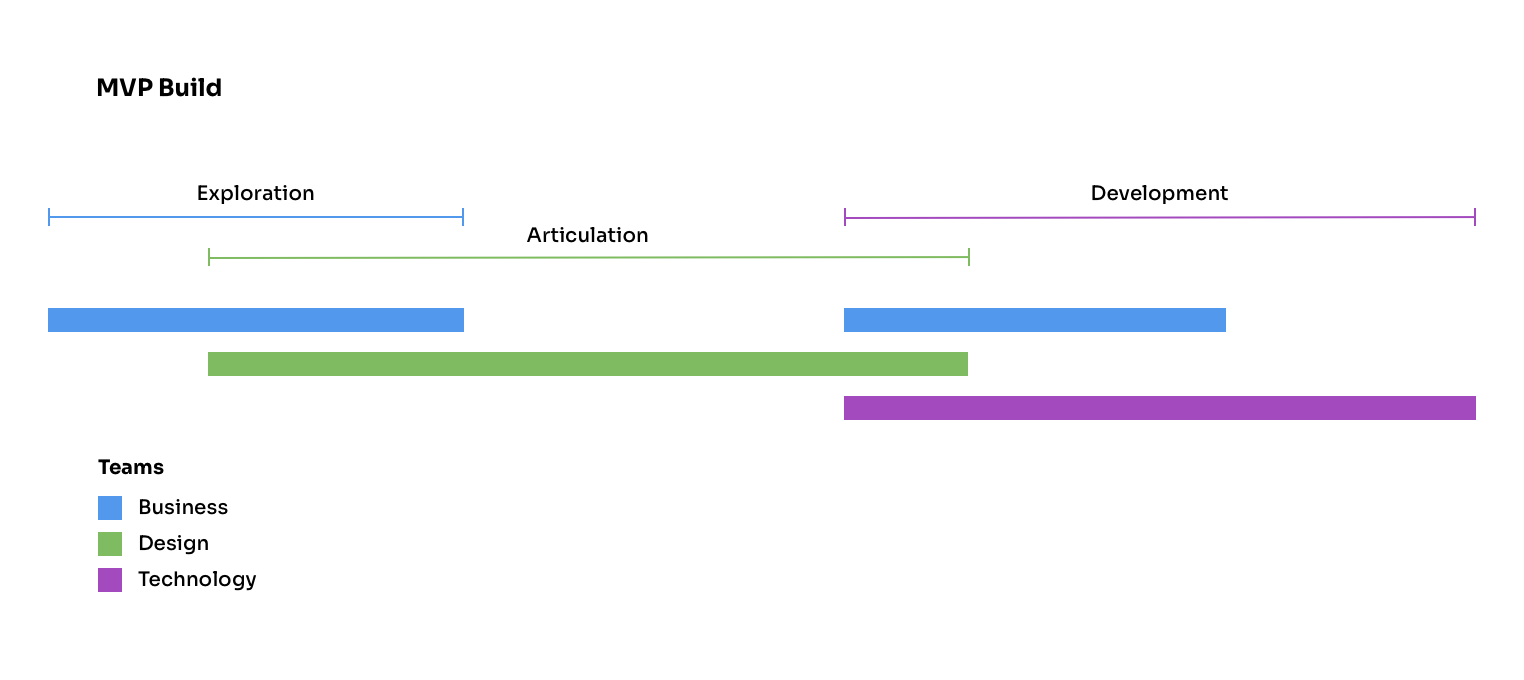
This is especially apparent when you are working with separate agencies for design and development. Let’s try to understand two critical points from the process flow above:
The product story that you wish to tell to your potential investors and customers starts taking form at the early stage, as the business identifies product needs and then engages with the design to put that vision in the form of screen designs.
When the technology team starts doing walkthroughs with the design team to understand the functionality and user flow, they start to look at it from a perspective of how they are going to develop the product.
If any feasibility issues crop up at this stage (and they mostly will), you have either of the two outcomes;
All features, but delay in product launch
On-time launch, but scaled-down features
Suddenly, your story does not hold up and is ripe for disappointment. Such a scenario is not unique to startups, and seen in larger corporations. One of the best examples is Tesla; when they launched the Model 3 in 2016, they planned to start deliveries of the Standard Range variant in 2017 but were not able to get regular deliveries started till 2019. Do note that when you are running a listed company, you cannot afford to sell a story that does not hold up to its promises! How then, can you ensure that you craft a story that successfully leverages the innovation
model?
Enable all the teams with the right tools and information right from the get-go. Understand that the teams you engage with are going to help you achieve the best of your goals. The more you involve them and allow them to excel at what they do best, the stronger is the outcome.
Be communicative and transparent about the business case and objectives. Business and client teams often like to keep design and technology teams at an arm’s length without communicating the realities of the business case. Transparency goes a long way to help teams stay motivated about what you wish to achieve. You need to be assured that the story sells internally before you sell it to your customers and investors.
Allow everyone across teams to discover and craft the story; do not write it by yourself. Business teams often make the mistake of dictating the story to the design and technology teams based on research and assumptions arrived at in isolation. Co-define the purpose of what you are trying to achieve and set clear roles for all collaborators within teams. This sets a clear path for successful collaboration and a story that you can sell confidently!
Understand what is achievable now and what the future looks like Customers and Investors like it when you have a long-term plan, even if it means getting access to necessary features further down the line. If you push too hard for something unachievable within your timeline, you risk not releasing a substandard product, but also setting a precedent of how you approach the product strategy. This will help you define three parts to your story; the premise, the vision and a path to the future!
Understand external dependencies These could be technological frameworks, government policies, and even resource providers. In spite of your core teams being well aligned, external factors can have a strong influence on your innovation process. It is always best to stay curious and question your solution from outside perspectives!
